

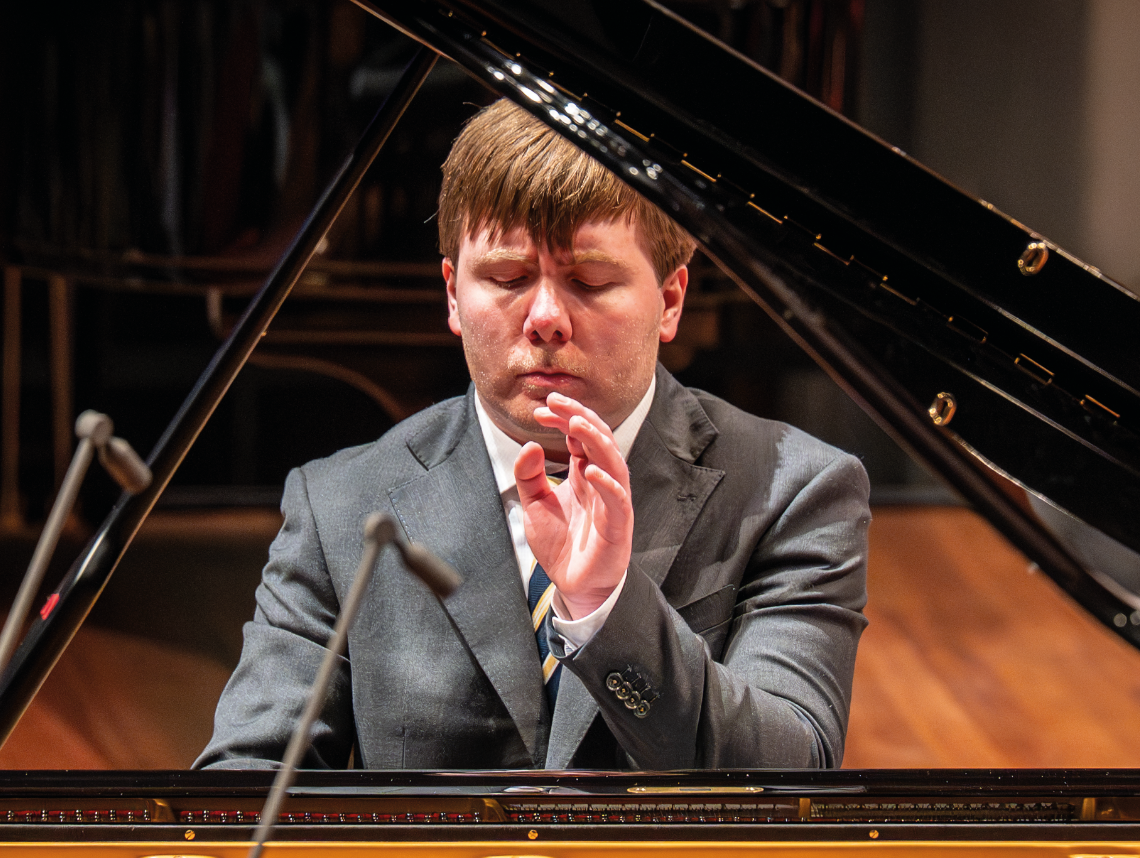
Thomas Kelly (Great Britain, 1998), winner of the 2nd Prize at the 2026 Liszt International Competition in Utrecht, trained at the Purcell School for Young Musicians and at the Royal College of Music, where -under the guidance of Dmitri Alexeev and Vanessa Latarche – he was awarded the prestigious Benjamin Britten Fellowship. In addition to distinguishing himself at the Leeds International Piano Competition in 2021 and the Hastings International Piano Concerto Competition (Second Prize, 2022), he has won several other international competitions, and in 2024, upon graduating from the Royal College of Music, he received The Queen Mother Rose Bowl. He collaborates with leading artists and appeared in the BBC Arts In Motion series with Yuja Wang. Supported by the Keyboard Charitable Trust and Talent Unlimited, he is scheduled to appear in recital at Wigmore Hall and in other major European venues in the near future.
Liszt Competition Utrecht
Liszt Utrecht is one of the principal gateways to the professional stage for young pianists. At the heart of its activities is the triennial International Piano Competition, founded in 1986 and hosted at TivoliVredenburg in Utrecht. Rather than focusing solely on the competitive element, the emphasis is placed on artistic expression, offering participants the opportunity to perform as part of a true festival, with both solo and chamber‑music programmes. For the final round, the competition collaborates with the Netherlands Radio Philharmonic Orchestra and high‑profile conductors, and presents the winner in concert at the Concertgebouw in Amsterdam. It is a member of the World Federation of International Music Competitions.
Subscriptions available from April 8 to 24 | Single tickets on sale on April 28, 2026.
Franz Liszt
(Raiding, 1811 – Bayreuth, 1886)
Les Préludes, S.511a
Poema sinfonico n. 3 (trascrizione per pianoforte)
Carl Maria von Weber
(Eutin, 1786 – Londra, 1826)
Konzertstück in fa minore, op. 79, S. 576a
(trascrizione per pianoforte di Franz Liszt)
Franz Liszt
(Raiding, 1811 – Bayreuth, 1886)
Fantasia e Fuga sul corale “Ad nos, ad salutarem undam”, S. 259